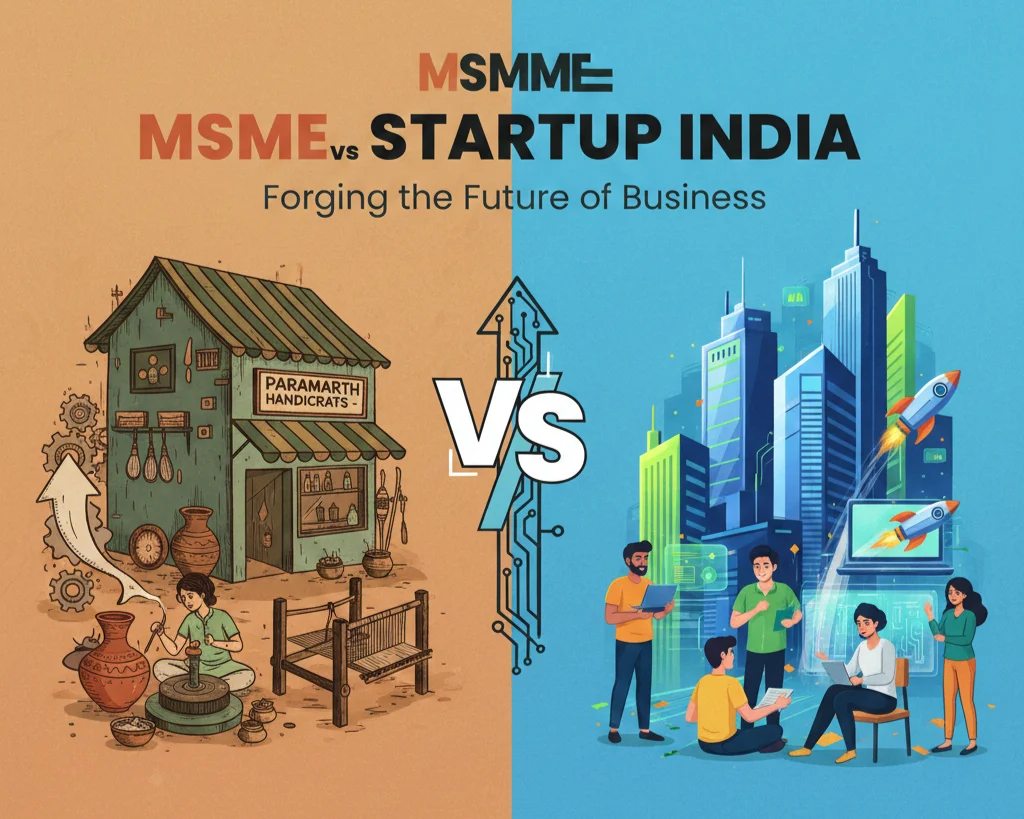
When you start your business in India, the first thing you get is a choice between two major paths that lead you to the government support system. Enlisting your business as an MSME (Micro, Small, and Medium Enterprise) under Udyam Registration or going for Startup India registration are the two most crucial decisions you will have to make. There are considerable government benefits on both routes, but those benefits are designed for different types of businesses and their respective growth ambitions.
The government of India has come up with solid measures to support startups and businesses at every stage, but choosing the right path for registration will determine which benefits you will be able to access. While some business people are of the opinion that they need to select one option only, the situation is actually more complicated. Let’s take a closer look at both options so you can make a decision that aligns with your aspirations for your business.
MSME Registration: The Foundation for Small Businesses
What is MSME Registration?
MSME Registration, which is also referred to as Udyam registration, is the classification system that the government has implemented for micro, small and medium enterprises all over India. In 2020, the Ministry of Micro, Small and Medium Enterprises launched Udyam Registration, which replaced the older Udyog Aadhaar system in order to simplify the registration process and make it fully digital.
MSME Classification Criteria
The MSME registration scheme classifies the companies according to two main criteria:
- Investment in Plant and Machinery
- Annual Turnover
The new classification (which came into effect in 2020) significantly raised the limits:
Micro Enterprises:
- Investment: Up to ₹2.5 crore
- Turnover: Up to ₹10 crore
Small Enterprises:
- Investment: Up to ₹25 crore
- Turnover: Up to ₹100 crore
Medium Enterprises:
- Investment: Up to ₹125 crore
- Turnover: Up to ₹500 crore
Note: These are composite criteria; your business must meet both investment and turnover limits.
MSME Registration Process
The ease of MSME registration is one of its most attractive features:
- Totally Free: No fees for registration, only professional fee.
- Entirely Online: Go through the process via udyamregistration.gov.in
- Very Little Documentation: Just Aadhaar number and PAN are needed
- Automated Verification: The system checks the details against government databases
- Lifelong Registration: No need to renew, certificate is valid for life
Key Benefits of MSME Registration
Access to Credit and Loans:
- Collateral-free loans through CGTMSE (Credit Guarantee Fund Trust for Micro and Small Enterprises)
- Priority lending from banks at lower interest rates
- Easier loan approval compared to non-registered businesses
Government Subsidies:
- Patent registration subsidies
- ISO certification support
- Electricity bill reductions
- Barcode registration assistance
Payment Protection:
- Protection against delayed payments from customers
- Claim interest compensation if payment exceeds 45 days under the MSME Development Act
Government Procurement Advantages:
- Priority in government tenders
- Exemptions from Earnest Money Deposit (EMD)
- Relaxed tender conditions compared to larger enterprises
- Preference in public procurement
Access to Government Schemes:
- MUDRA (Micro Units Development and Refinance Agency)
- PMEGP (Prime Minister Employment Generation Programme)
- PM Vishwakarma Yojana
- ZED Certification support
- Capital assistance tailored for small businesses
Startup India Registration: Targeting Innovation and Rapid Growth
What is Startup India?
Startup India registration (which is also known as DPIIT recognition) is a major program of the Department for Promotion of Industry and Internal Trade that aims at the innovators who are building up high-growth potential businesses. The initiative prioritises technological and scalable solutions to the problem rather than the company size metrics.
Startup India Eligibility Criteria
To qualify for Startup India registration, your business must meet specific requirements:
Legal Structure:
- Must be a Private Limited Company, Limited Liability Partnership (LLP), or Registered Partnership Firm
- Sole proprietorships cannot register
Age Requirement:
- The company must be less than 10 years old from the incorporation date
- Targets newer ventures with growth potential
Turnover Limit:
- Annual turnover must not exceed ₹100 crore in any financial year since inception
Innovation Requirement:
- Must demonstrate innovation, scalability, or a novel approach to problem-solving
- Innovation can be technological, business model-based, or process-oriented
Formation Restriction:
- Cannot be formed by splitting or reconstructing an existing venture
- Targets genuinely new enterprises
Startup India Registration Process
The DPIIT recognition process involves:
- Platform: National Single Window System (NSWS) portal
- Documentation: Certificate of Incorporation, innovation details, scalability proof
- Verification Timeline: 2-7 working days
- Cost: Completely free
- Output: E-certificate with unique recognition number
Key Benefits of Startup India Registration
Income Tax Exemption:
- Three-year income tax exemption under Section 80-IAC
- Retain profits during the critical growth phase
- Reinvest capital without a tax burden
Angel Tax Exemption:
- Angel Tax exemption under Section 56
- Investors’ contributions are not taxed even if exceeding fair market value
- Crucial advantage for early-stage capital raising
Intellectual Property Support:
- 80% rebate on patent filing fees
- Fast-track examination of patent applications
- Government rebates on trademark filings
Regulatory Relief:
- Self-certification for labour compliance (5 years)
- Self-certification for environmental compliance (5 years)
Funding Access:
- Access to ₹10,000 crore Fund of Funds
- Direct access to venture capital support
- Preferred by angel investors and accelerators
Government Procurement:
- Participation in government tenders without prior experience
- No turnover prerequisites
- Exemptions from Earnest Money Deposit (EMD)
Ecosystem Support:
- Networking through startup festivals
- Incubator and accelerator partnerships
- Mentorship and collaborative opportunities
MSME vs Startup India: Detailed Comparison
Classification Approach
| Aspect | MSME | Startup India |
| Type | Quantitative (size-based) | Qualitative (innovation-based) |
| Focus | Investment & turnover figures | Innovation & scalability |
Business Age and Entity Structure
| Aspect | MSME | Startup India |
| Age Limit | No age limit | Max 10 years old |
| Eligible Entities | Sole proprietor, Partnership, LLP, Company | Private Limited, LLP, Partnership only |
Financial Support Mechanisms
MSME Focus:
- Credit-based support (loans and financing)
- Subsidies on operational expenses
- Preferential lending rates
- Government guarantee schemes
Startup India Focus:
- Equity-based support (investor funding)
- Tax-based support (exemptions)
- Venture capital ecosystem access
- Angel investment facilitation
Growth Models Suited
MSME Registration Suits:
- Steady, sustainable growth
- Traditional business model optimisation
- Market share expansion
- Operational efficiency improvements
- Long-term profitability focus
Startup India Suits:
- Rapid, disruptive growth
- High-growth potential
- Exponential revenue scaling
- Innovation-driven business models
When to Choose MSME Registration
Business Profile Match
Choose MSME registration if:
- Your business is well-established and has been running profitably for several years
- You’re in manufacturing, retail, services, or traditional trading
- Your business structure is a sole proprietorship or a partnership
- Your growth model emphasises steady expansion and operational efficiency
- Your competitive advantage lies in execution and customer service
Financing Requirements
MSME registration is ideal when:
- Your primary financing need is bank loans and credit access
- You need ₹5-50 lakhs for working capital or equipment
- You lack substantial fixed assets to pledge as collateral
- You want collateral-free lending options
- You prefer traditional financing over venture capital
Operational Support Needs
Choose MSME if you prioritise:
- Subsidies on ISO certification and patent protection
- Electricity cost reductions
- Barcode registration assistance
- Priority in government tenders
- Payment protection against customer delays
Clarity and Simplicity
MSME registration is better if:
- You’re uncertain about proving “innovation” to regulators
- You want immediate registration without verification complexity
- You need permanent recognition without ongoing compliance
- You prefer a straightforward, quick registration process
When to Choose Startup India Registration
Innovation-Driven Business
Choose Startup India if:
- Your business is built on genuinely innovative ideas or novel technology
- You’re solving existing market gaps with unique approaches
- Your business addresses problems through disruptive models
- You’re in software, edtech, fintech, healthtech, or deeptech sectors
- Your competitive advantage is technological superiority
Capital Raising Strategy
Startup India registration is essential when:
- You’re seeking venture capital or angel investment
- External funding exceeds ₹1 crore requirement
- Investor expectations include government recognition
- You need credibility signals for fundraising
- You want access to Fund of Funds and accelerator programs
Intellectual Property Focus
Pursue Startup India if:
- Patents are crucial for a competitive advantage
- Your business relies on proprietary technology
- Trademark or design protection is important
- You need rapid patent protection
- IP cost reduction saves significant capital
Growth Trajectory
Choose Startup India for:
- Projected rapid scaling (zero to significant revenue in 3-5 years)
- Exponential growth expectations
- Plans to reach ₹100+ crore revenue
- Intent to disrupt existing markets
- Building a scalable technology platform
Investor and Ecosystem Access
Startup India offers:
- Direct access to venture capital networks
- Angel investor preference and credibility
- Accelerator and incubator partnerships
- Government-backed funding opportunities
- Networking at startup festivals
The Power of Dual Recognition: MSME and Startup India
Why Pursue Dual Registration?
The most advanced and elaborate strategy consists of getting the two registrations at once. A company that meets MSME requirements can register as an MSME and, at the same time, seek Startup India recognition, thus receiving the greatest amount of government assistance possible.
Benefits of Dual Recognition
Financial Advantages:
- Access collateral-free CGTMSE loans at preferential rates
- Enjoy a three-year income tax exemption
- Receive patent filing rebates from both schemes
- Benefit from subsidies on operational expenses
Funding Flexibility:
- Raise venture capital through the Startup India ecosystem
- Maintain the option for government-backed loans
- Access Fund of Funds simultaneously with MUDRA options
- Combine equity and debt financing strategies
Procurement and Compliance:
- Eligible for government tenders under both schemes
- Expanded scope of government procurement opportunities
- Self-certification benefits for regulatory compliance
- Priority status in both MSME and startup procurement
How to Achieve Dual Recognition
Requirements:
- Meet the investment and turnover criteria for your MSME category
- Demonstrate genuine innovation and scalability
- Maintain DPIIT startup recognition status
- Annual turnover below ₹100 crore
- Private Limited, LLP, or Partnership structure
Registration Approach:
- Pursue MSME registration first (fastest, immediate benefits)
- Simultaneously apply for DPIIT recognition
- Both registrations operate independently
- No conflicts between dual registrations
- Maximum benefits without abandoning either pathway
Making Your Decision: A Practical Framework
Three Key Decision Questions
Question 1: Business Model Focus
- Does your business emphasise innovation and rapid scaling?
- YES → Consider Startup India registration
- NO → MSME registration better aligns with steady growth
Question 2: Funding Strategy
- Is external venture capital central to your growth plan?
- YES → Startup India registration is essential
- NO → MSME registration supports self-funded or bank-financed growth
Question 3: Business Structure and Age
- Are you operating as a recent private company/LLP (under 10 years)?
- YES → Both pathways available; choose based on innovation
- NO → MSME registration remains your primary option
Implementation Strategy
Step 1: Register as MSME First
- Simplest and fastest pathway
- Provides immediate benefits
- Free and permanent registration
- Takes minutes to complete
Step 2: Evaluate DPIIT Recognition
- Assess whether your business truly demonstrates innovation
- Determine if venture funding is part of your growth strategy
- Evaluate tax exemption benefits for your situation
- Plan investor fundraising timeline
Step 3: Pursue Dual Recognition (if applicable)
- Apply for Startup India recognition if both criteria are met
- Combine the benefits of both schemes
- Maximize government support for infrastructure
- Optimize financial and operational advantages
Conclusion
The decision of whether to register with MSME or Startup India is not an either-or situation; rather, it is a strategic choice that is in line with your business model, growth plans, and funding needs.
Udyam MSME Registration offers the widest support base possible, open to almost any business structure; it gives immediate access to credit, subsidies, and government procurement advantages.
On the other hand, Startup India Registration is meant for innovation-driven businesses that are looking for quick growth, and it offers tax benefits with substantial amounts as well as access to the venture capital ecosystem.
The most effective solution is the combination of both registrations, which will lead to the establishment of a comprehensive government support infrastructure that not only speeds up growth but also makes the best use of financial resources.