The choice of business structure is one of the most important decisions any entrepreneur must make at the beginning of their business. In India, the two most common options are Private Limited Company (Pvt Ltd) and Limited Liability Partnership (LLP). The current guide provides a detailed explanation of the differences between Private Limited Company and Limited Liability Partnership, lists the legal and practical differences, and suggests which structure would best fit your business goals. By looking at everything from compliance to everyday operations, funding options, and risk exposure, this article guarantees that you not only grasp the concept of Pvt Ltd vs LLP but can also quickly reply to all the frequently asked questions searched online.
Understanding the Basics
Before going any further with the LLP vs Pvt Ltd issue, let us clarify what each entity really is.
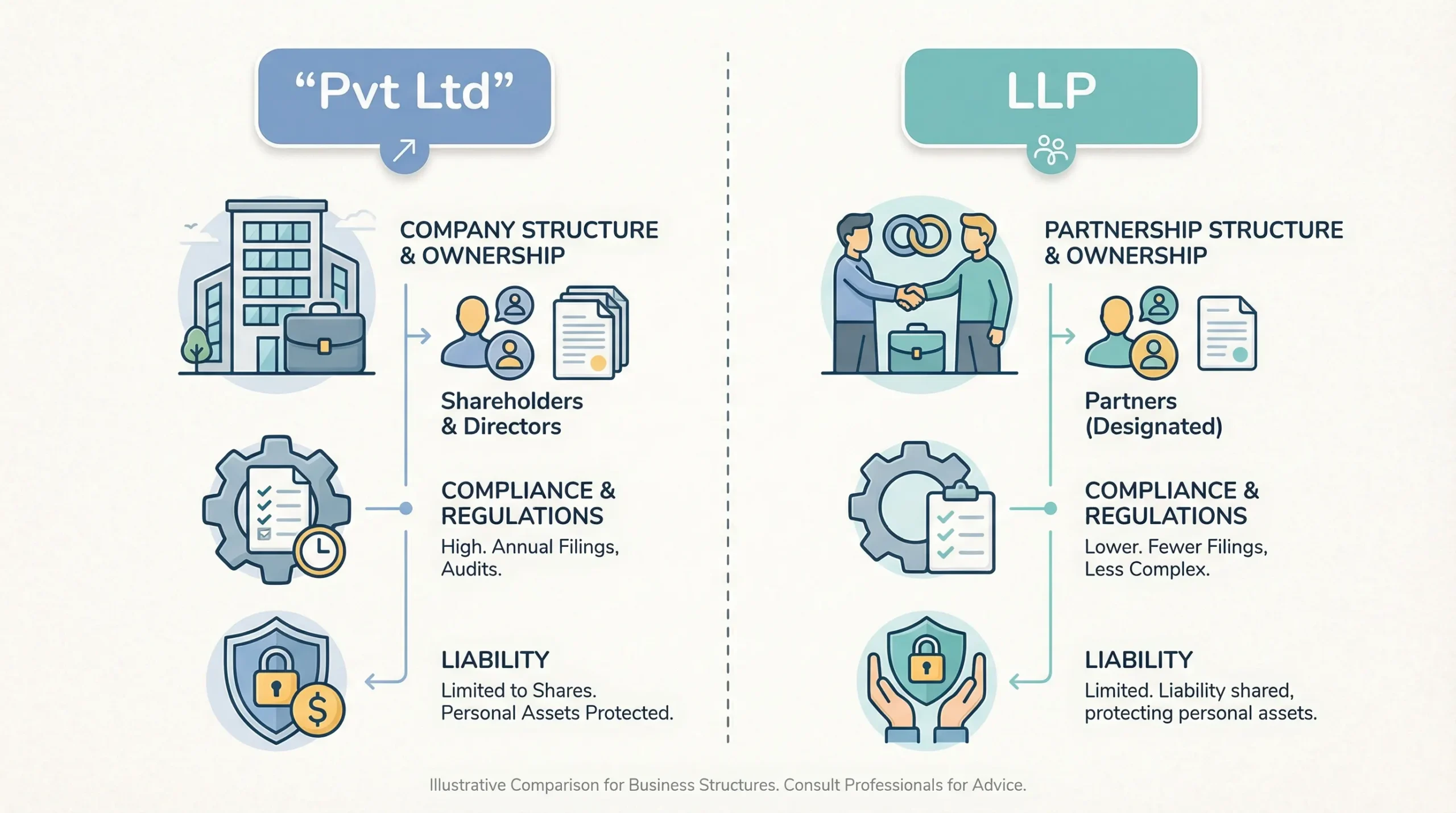
- Private Limited Company (Pvt Ltd): The company is owned by shareholders and is privately held, getting a separate legal entity. It is controlled through the Companies Act, 2013. There can be a maximum of 200 shareholders and their shares will not be traded on the stock exchange. The roles of owners and managers are different; directors are managing the daily activities while shareholders are considered the owners.
- Limited Liability Partnership (LLP): LLP is a hybrid of a partnership and a company. Partners can manage the business under the LLP Act of 2008, and their liability is limited to the amount they have contributed to the business. There are no shareholders, just partners and their agreement.
Ownership and Management Structure
Pvt Ltd vs LLP – Who Runs the Show?
- Pvt Ltd:
- It is the shareholders (owners) who are responsible for appointing the directors that will manage the company.
- The shareholders are not normally involved in the daily management decisions; these are left to the directors.
- As the shares can be transferred to other shareholders, it makes the transition in ownership much easier.
- LLP:
- The partners are owners as well as managers.
- The decision-making is straightforward, and the daily activities are governed by the LLP agreement.
- Error! Ownership is less flexible; profit sharing and transfer of rights require unanimous agreement among partners.
| Aspect | Pvt Ltd | LLP |
| Owners | Shareholders | Partners |
| Managers | Directors | Partners |
| Transfer of Rights | Via shares – easy | Via agreement – consensus needed |
| Compliance Needs | High – MOA, AOA, meetings | Low – LLP agreement suffices |
Legal Framework and Liability
Limited Liability Partnership vs Private Limited Company – Who’s Protected?
Liability Protection:
- In the case of Pvt Ltd and LLP, the business debts and risks do not affect the personal assets of the owners.
- The shareholders and directors of a Pvt Ltd company are liable only to the extent of their capital investment in shares.
- The LLP partners are liable for the amount of their capital only and thus are protected from any other personal liability.
Legal Status:
- In both cases, the entities are legally distinct from the owners.
- Private limited companies have to follow the rules and regulations set forth by the Companies Act, 2013.
- In the case of LLP, though, the LLP Act, 2008, is applicable, which has relatively less formalities compared to the Companies Act.
Taxation – LLP vs Pvt Ltd
Tax Structure Comparison
LLP:
- Taxed as a partnership (30% flat rate plus an additional charge and cess).
- Partners’ remuneration can be claimed as a deduction.
- No Dividend Distribution Tax (DDT).
Pvt Ltd:
- Taxed at the corporate rate (25%-30% plus surcharge and cess).
- DDT is charged if dividends are paid out.
- Director’s salary and shareholder’s interests are subject to regulation.
| Entity | Tax rate | Dividend Tax | Remuneration |
| LLP | 30% + surcharge/cess | None | Deductible to partners |
| Pvt Ltd | 25%-30% + surcharge | Applicable | Director’s salary allowed per law |
Compliance and Regulatory Burden
Private Limited vs LLP – Who Has More Paperwork?
Pvt Ltd:
- Mandatory filings every year: AOC-4 & MGT-7.
- Regular board meetings (minimum four times a year).
- Statutory audits are required regardless of turnover.
LLP:
- Filing of annual Statement of Accounts (Form 8) and Annual Return (Form 11).
- Audits would be necessary only if turnover exceeds ₹40 lakh or contribution exceeds ₹25 lakh.
- Non-need for board or general meetings makes compliance easier.
In terms of compliance, an LLP definitely has a much more relaxed regime when compared to a Pvt Ltd company registration.
Capital Raising and Funding Options
LLP vs Private Limited – Which Is Better for Investment?
- Pvt Ltd:
- Can issue shares to raise equity capital.
- Preferred structure by venture capitalists, angel investors and external funders.
- Ionic for scalable startups seeking rapid expansion; investor exits are smoother via share transfers.
- LLP:
- Cannot issue shares – raising equity capital is not possible.
- Funding usually limited to partner contributions or loans.
- Less attractive for large institutional or angel investors.
For startups with high growth ambitions, Private Limited companies clearly have the edge.
Day-to-Day Operations
Flexibility and Business Scalability – LLP vs Pvt Ltd
- LLP:
- Decision-making becomes more flexible: the LLC agreement stipulates that a consensus is reached among the partners.
- It is a good option for professional services, freelancers, legal or accounting firms.
- Profit distribution and operational changes need the agreement of all parties involved.
- New branches can be established, but the contributions of partners usually limit this.
- Pvt Ltd:
- Very organized – rules of corporate governance, voting by shareholders, and different classes of shares.
- Best for companies that want to have subsidiaries, merge, or acquire other businesses.
- New shareholders can easily be added.
- Global expansion is easy, as it is just following the rules of the Companies Act.
Market Perception and Credibility
LLP vs Private Limited – Building Trust and Reputation
- Pvt Ltd:
- More accepted by banks, suppliers, and major customers.
- Companies prefer them when they require trustworthy counterparts in contracts.
- LLP:
- Seen as a minor or professional business form.
- Most suitable for consultancy, small businesses, or family-owned companies.
In case your enterprise wants to allure outside stakeholders or raise its worth, then Pvt Ltd is the only way.
Exit Options and Transferability
LLP vs Pvt Ltd – Can You Leave or Sell Easily?
- Pvt Ltd:
- The company offers a smooth process for exits and transfers; hence, the shares of the company are transferable.
- The liquidity is thus enhanced through public listing and share buyback options.
- LLP:
- The existence of the partnership is a double-edged sword, for it makes exit very complicated, and this often necessitates the consent of all partners.
- Retirement of one partner or change of ownership is completely governed by the LLP Agreement.
- The transfer of partnership rights is usually subject to the amendment of the LLP contract.
Asset Management
Limited Liability Partnership vs Private Limited on Ownership
- Both parties are capable of possessing real estate and non-material goods rights.
- Pvt Ltd has powerful systems for gathering assets and using them as security (for borrowing) in place.
- LLPs may likewise possess property; however, growth through the use of assets is dependent on agreement among the partners.
Registration Process
Private Limited vs LLP – Getting Started in India
Pvt Ltd Registration:
- Digital Signature Certificates (DSC) and Director Identification Number (DIN) should be obtained first.
- Then, choose the name and write Memorandum of Association (MOA) and Articles of Association (AOA).
- At least 2 shareholders and 2 directors are required.
- The company has to be registered with the Ministry of Corporate Affairs (MCA).
LLP Registration:
- Obtain the DSC for the partners.
- Reserve the name and submit the incorporation form.
- The drafting and Stamp duty on LLP Agreement are necessary.
- There must be at least 2 designated partners (one of whom should be an Indian resident).
Compliance and Annual Filings
| Requirement | Pvt Ltd | LLP |
| Annual returns | AOC-4, MGT-7 | Form 8, Form 11 |
| Audit requirements | Mandatory for all | Only if turnover > ₹40 lakh or capital > ₹25 lakh |
| Meetings | Board meetings compulsory | Not required |
Pvt Ltd firms face significantly heavier paperwork and statutory audits.
LLP vs Pvt Ltd – Which Should You Choose?
Key Questions to Answer
Choose Private Limited Company if:
- You are looking for investors, venture capital, or external support in the form of funding.
- Your ambitions include great expansion, setting up branches, or going public.
- Your company requires a trustworthy, corporate-like appearance to be able to form external partnerships.
Choose LLP if:
- Your business model is self-financed and stable.
- You prioritize operational flexibility and low compliance costs.
- Your area of work is professional service, consulting, or small business needs.
Consider your growth vision, business model, and funding strategy before making the choice.
Case Study: Practical Scenario
Startups vs Professional Firms
A tech startup that is targeting quick scaling, attracting institutional investors, and going global will prosper as a private limited company since it will be able to clearly delineate the ownership, establish strong governance, and gain trust.
In contrast, a legal or accounting firm that operates under a partnership model, has low compliance requirements, and generates a steady income stream might consider the LLP structure to be a more efficient and suitable option, allowing the partners to exercise management, profit sharing, and adaptation according to their needs.
Final Thoughts
Choosing between Pvt Ltd and LLP is a self-evident question, it is simply a question of core business strategies. The debate between Limited Liability Partnership and private limited company offers relaxed compliance, agility and low operational overheard while Private Limited and LLP are inclined towards Pvt Ltd for fundraising, scaling and reputation building. Both LLP vs private limited company have the power to own assets, personal risk protection and strong companies; the right choice would be based on your precise operational, financial, and strategic needs.
Startups and mature businesses have to go through pros and cons of LLP vs Pvt Ltd, guaranteeing compliance and success at the same time. It is highly recommended to consult a professional advisor or a lawyer before registering and to review your five-year and exit plan in order to keep your vision on track.
This blog covers everything comprehensively that entrepreneurs, freelancers, and business owners in India usually inquire about when Limited Liability Partnership vs private limited company is the case. If your objectives are to grow quickly, streamline compliance, secure funding, or run a cost-effective operation, then knowing the difference between Pvt Ltd and LLP will surely facilitate your decision-making process.
Frequently Asked Questions (FAQs)
1. What are the main differences between an LLP and a Private Limited Company?
LLPs are indeed characterized by their flexible management alongside their lesser compliance burdens, to be sure. On a contrary note, Private Limited Companies boast of higher credibility, more accessible external funding, and investors.
2. Which option is more cost-effective: LLP or Pvt Ltd?
LLPs are overall less expensive because of the lower registration costs, fewer compliance measures, and on the other hand, Pvt Ltd companies, regardless of their size, are subjected to higher compliance and audit costs.
3. Can LLPs raise venture capital or equity investment?
No, LLPs cannot give out shares and as a result, they are not the right candidates for equity-based funding.
4. What are the compliance requirements for LLPs and Pvt Ltd companies?
Annual board meetings, filing of multiple annual reports and also getting a statutory audit done, regardless of their turnover, are required for pvt ltd companies compliance. But, LLPs are only required to file Form 8 and Form 11 every year and to conduct audits only if their turnover exceeds ₹40 lakh or their capital contribution exceeds ₹25 lakh.
6. Which structure provides better tax benefits – LLP or Pvt Ltd?
LLPs are taxed at a flat 30%, whereas Pvt Ltd companies enjoy lower rates for small companies and may get incentives in certain sectors. In addition, Pvt Ltd firms incur extra tax on dividends, but LLP profits are distributed without DDT.
7. Which is better for a startup in India: LLP or Pvt Ltd?
Usually, a Pvt Ltd company is the best choice for startups that anticipate rapid growth, plan to raise external funds, or set up ESOPs. LLPs are suitable for professional firms, consultancies, or other partner-operated businesses.